“People are not just numbers.”
For Susan Weisman, Westchester County’s Food Security Coordinator, that belief is at the heart of hunger-relief work. Every statistic represents a person, a family, or a neighbor with a story, a challenge, and hopes for the future.
Behind every number is someone making hard choices. They may be deciding whether to pay rent, cover childcare, afford medication, or put food on the table. Although Westchester is often seen as a place of abundance, hunger exists in every corner of our community.
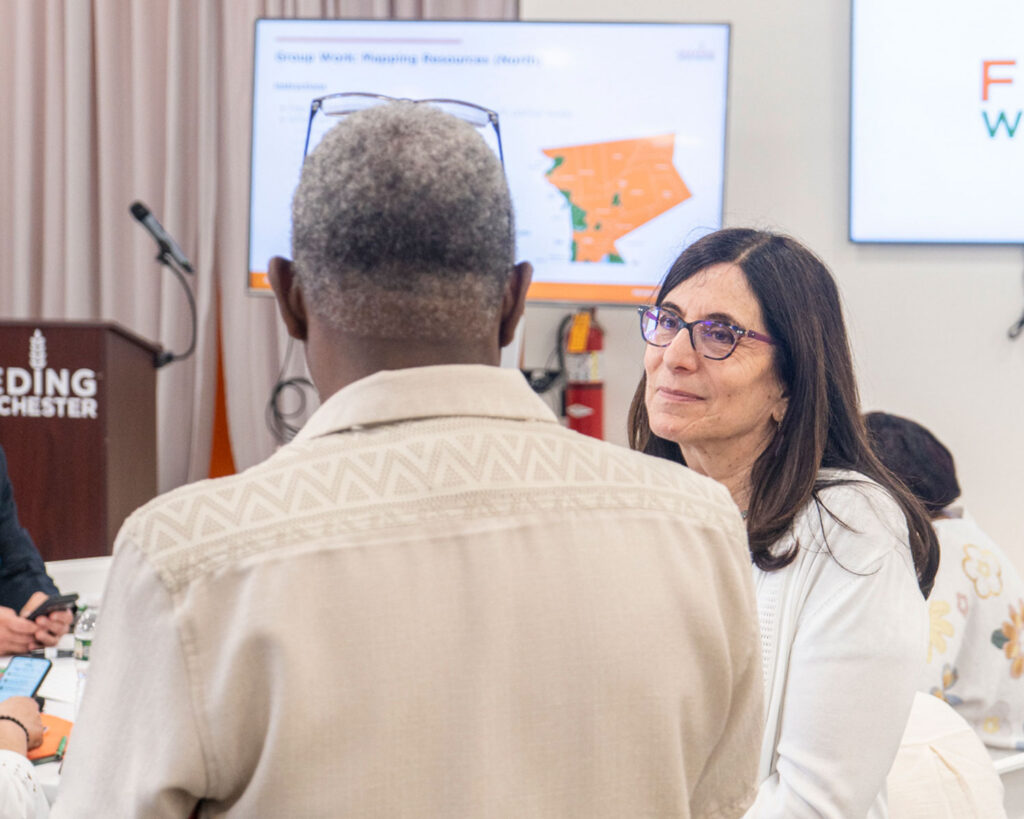
Susan has seen this reality up close through her work across Westchester County. She has also seen what happens when people come together with care, consistency, and a shared commitment to help their neighbors.
“Partnerships are my sweet spot, because I am a real believer in them,” she shared.
That belief shows up throughout Westchester’s hunger-relief network. Feeding Westchester, community organizations, local government, volunteers, and local leaders all play a role. Together, they help create a stronger system of support.
As a result, neighbors can connect to food and other resources closer to home. Just as importantly, they can feel seen, heard, and supported.
Susan has learned that this work goes far beyond providing food. It starts with listening. Then, it requires understanding each person’s situation and responding with compassion.
In many cases, food is only one part of what a neighbor may need. A family may also need household items, transportation support, or help finding other local resources. Because of strong partnerships, pantry teams and volunteers can often help connect people to more support.
Susan remembers moments when volunteers and partner food pantry teams stepped in beyond the pantry line. In one case, they helped a neighbor settle into a new apartment with basic necessities. In another, they made sure a child had sneakers so they could join their sports team.
These moments may seem small. However, they reflect something much larger. They show what it means for a community to see people fully and show up in meaningful ways.
“I wasn’t just helping them. They were helping me too,” Susan reflected. Through these relationships, she gained perspective, connection, and a deeper understanding of the people behind the work.
Today, the challenges facing our neighbors continue to change. Rising costs, changes to federal nutrition programs, transportation barriers, and the high cost of living can make food harder to access.
For many families, even a small increase in monthly expenses can create difficult choices. Because of this, consistent access to nourishing food is more important than ever.
Today, more than 1 in 3 Westchester households are at risk of hunger. Through Feeding Westchester’s network of 175 partners and programs, neighbors can access nourishing food and other resources close to home when they need them most.
Even with these challenges, Susan continues to see reasons for hope.
She has seen neighbors who once turned to a food pantry for support return as volunteers. Now, they are ready to help someone else. She has also watched partnerships grow stronger, communities come together, and people give their time and energy to support their neighbors.
These acts of care matter. They remind us that hunger relief is not only about food. It is also about dignity, trust, and connection.

Addressing hunger is not the responsibility of one organization or one person. Instead, it takes all of us.
Neighbors, volunteers, donors, community partners, and advocates each have a role to play. Together, we can build a community where everyone has access to the food they need today. We can also help create the resources and stability needed for a better tomorrow.
Because when we look beyond the numbers, we see what has always been at the center of this work: people, relationships, and a shared commitment to care for one another.