Gladys is building a better tomorrow for her family and helping others do the same.
The first time Gladys walked through the doors of the Community Food Pantry of Tarrytown and Sleepy Hollow, she felt uneasy.
“I just wanted to cry,” she says. “Not being able to provide for my family made me feel awful.”
She made herself go in anyway. That quiet act of courage changed everything.
Gladys lives in Tarrytown with her husband, her mother, and two children under three. Her family works hard. They make careful choices. And they still face a cost of living that outpaces what they can afford.
When her son was born, Gladys had to stop working.
The math was brutal. Daycare runs $450 to $500 a week. “I’d basically be working just to pay for gas and daycare,” she says. With two young children at home, that reality has not changed. Their rent is nearly $2,500 a month.
After rent, utilities, transportation, diapers, and clothes for growing kids, there is almost nothing left. On paper, the household earns too much to qualify for Supplemental Nutrition Assistance Program, or SNAP, benefits. In reality, it is still not enough. That gap between wages, eligibility, and what life actually costs is one that thousands of Westchester families know all too well.
The pantry helps fill it.
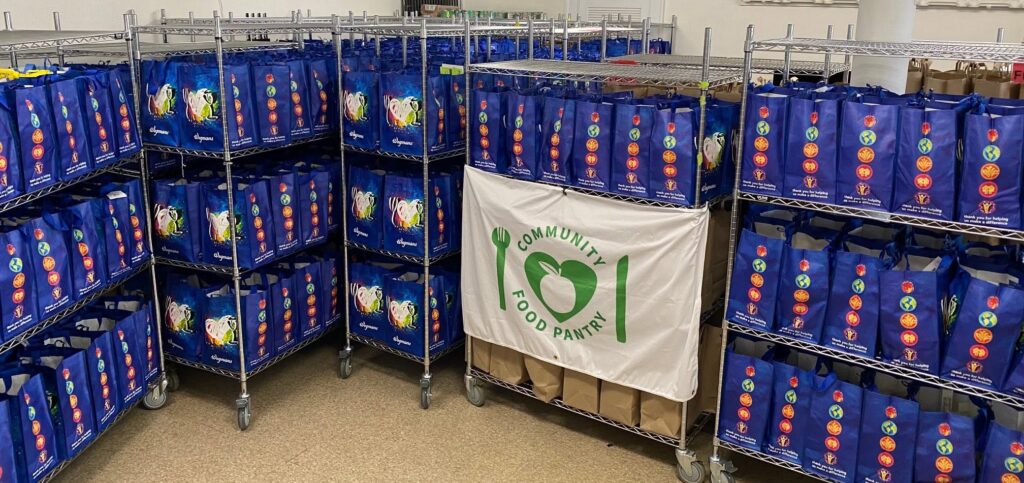
“This pantry means a lot to us,” Gladys says, “because at least once a month, we know we’ll have something secure.”
But what she remembers most is not only just the food. It is the way she was treated when she arrived.
“People here are so kind,” she says. “You don’t feel judged.”
That feeling stayed with her. Now Gladys volunteers at the pantry herself, helping neighbors who arrive with the same nerves she once carried.
“We are here to help you,” she tells them. “And me personally, I understand what you’re going through.”
She is also building her future. Gladys is taking health information classes at Westchester Community College, working toward a career that fits her family’s life. She is doing everything at once, raising children, caring for her mother, studying, and volunteering, held together by the same conviction that runs through everything she does.
“When I can feed them, cook for them, and take care of them,” she says, “that brings me peace.”
Gladys has a message for anyone who might be standing outside a place like this, afraid to walk in.
“Don’t be afraid. You’re not going to lose anything by asking for help.”
She knows what it costs to ask. She also knows what it can give back.
Her story is a reminder that hunger in Westchester does not always look the way people expect. It lives in working households, in families doing everything they can, in parents who love their children fiercely and still cannot make the numbers add up. It is hidden, and it is everywhere.
And when neighbors are met with dignity, when someone looks at them and says I understand what you’re going through, they do not just get through the month. They become part of something larger.
“This is a big family,” Gladys says. “And we’re willing to help.”