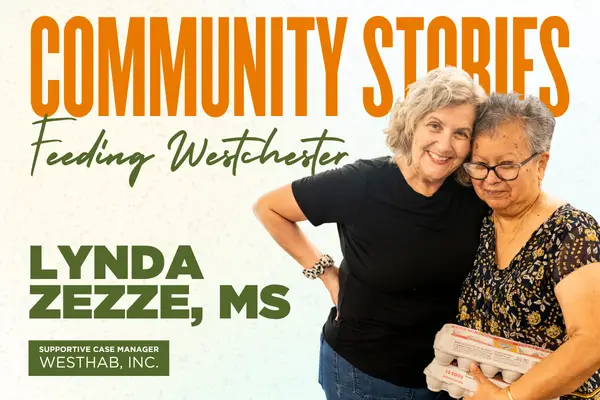
At Ludlow Commons in Yonkers, the groceries residents pick up each month rarely stay in one apartment.
Ludlow Commons, an affordable senior living community, works with the Yonkers Community Action Program (YCAP) to distribute groceries to residents each month. On the first floor, Lynda Zezze, a supportive case manager with Westhab, Inc., greets neighbors as they stop by for fresh produce, protein, dairy, and other staples. She has been here since the early days of the pandemic, when she first began looking for food partners for the building, and in that time she has come to know the rhythms of the place.
“Some of us are like family here,” Lynda said. “Every morning we greet each other, and I love coming because you can see how much they care about each other.”
That care shows up in the ordinary business of who cooks for whom.
One of those kitchens belongs to Ram and his wife, Wendy. They have lived in Yonkers for 27 years, and Wendy does the cooking, drawing on the Indo-Trinidadian flavors they grew up with, while Ram handles the shopping. The meals coming out of their kitchen are not only for the two of them. Wendy regularly cooks for neighbors throughout the building, which means the groceries Ram carries upstairs end up nourishing a much wider circle than the two people living in the apartment.

“With everything going on in the world right now, this food helps me so much,” Ram said.
For Ram, the distribution eases some of the pressure of rising grocery costs. It also supports something already woven into his and Wendy’s daily life.
In the same building, the same instinct takes a different shape. Mercedes has two sisters who also live at Ludlow Commons, and the three of them treat each month’s groceries as a shared supply.
“This food is such a blessing, especially with all the activities they have here,” Mercedes said. “And I can help my sisters who live in the building, too. We’re constantly sharing the great items we get.”
Lynda sees this everywhere she looks.
“Whatever we provide, they’re either going to use it themselves or give it to a neighbor,” she said. “Someone will say, ‘I’m bringing this to my sister who lives down the hall.’ It’s amazing.”
Food moves apartment to apartment based on what people need, what they enjoy, and what they know someone else will use. But generosity has limits, and those limits are set by what residents can afford and reach on their own.
Maria was among the last residents to stop by that morning.
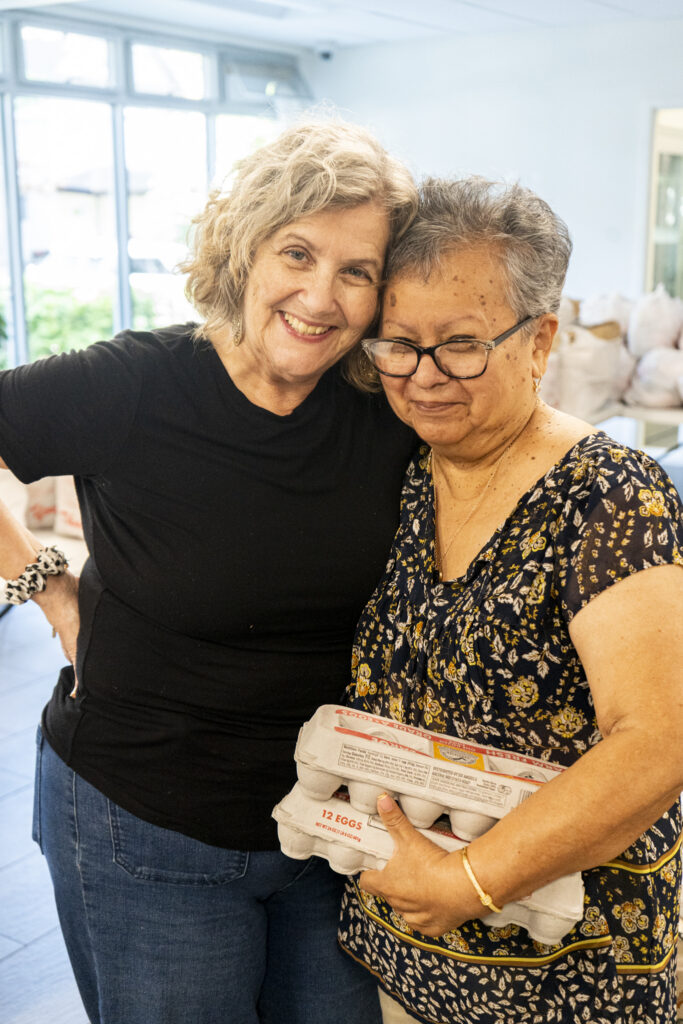
“This food helps so much,” she said. “Everything is so expensive right now.”
It is a concern Lynda hears constantly, and the cost of groceries is only part of it. For some residents, the harder problem is getting to a store where nutritious food is affordable in the first place. Some take the bus. Some rely on taxis. Others walk to small neighborhood shops, where the selection is narrower and prices can run higher.
“People are having to choose the cheaper thing, and the cheaper thing often isn’t the healthier thing,” Lynda said. “Our residents are cognizant of what’s in their food. They just can’t always afford the option they’d choose.”
Which is why certain items in the distribution draw the most attention.
“They ask me every week: is there eggs today, is there cheese, is there milk,” Lynda said. “Protein is what they’re most grateful for.”
Feeding Westchester’s Senior Grocery program is designed to support better health and independent living for older adults by helping make nutritious food more accessible. At Ludlow Commons, the eggs, cheese, and milk that residents ask about by name reach well past the apartments they are carried into. A bag of groceries may become one of Wendy’s shared meals, or an item Mercedes passes to a sister down the hall.